
This article by Martin Grahl first appeared in issue 06/2021 of vidom, the members’ magazine of Leica HISTORICA e.V. This English version was translated from the original German text using AI.
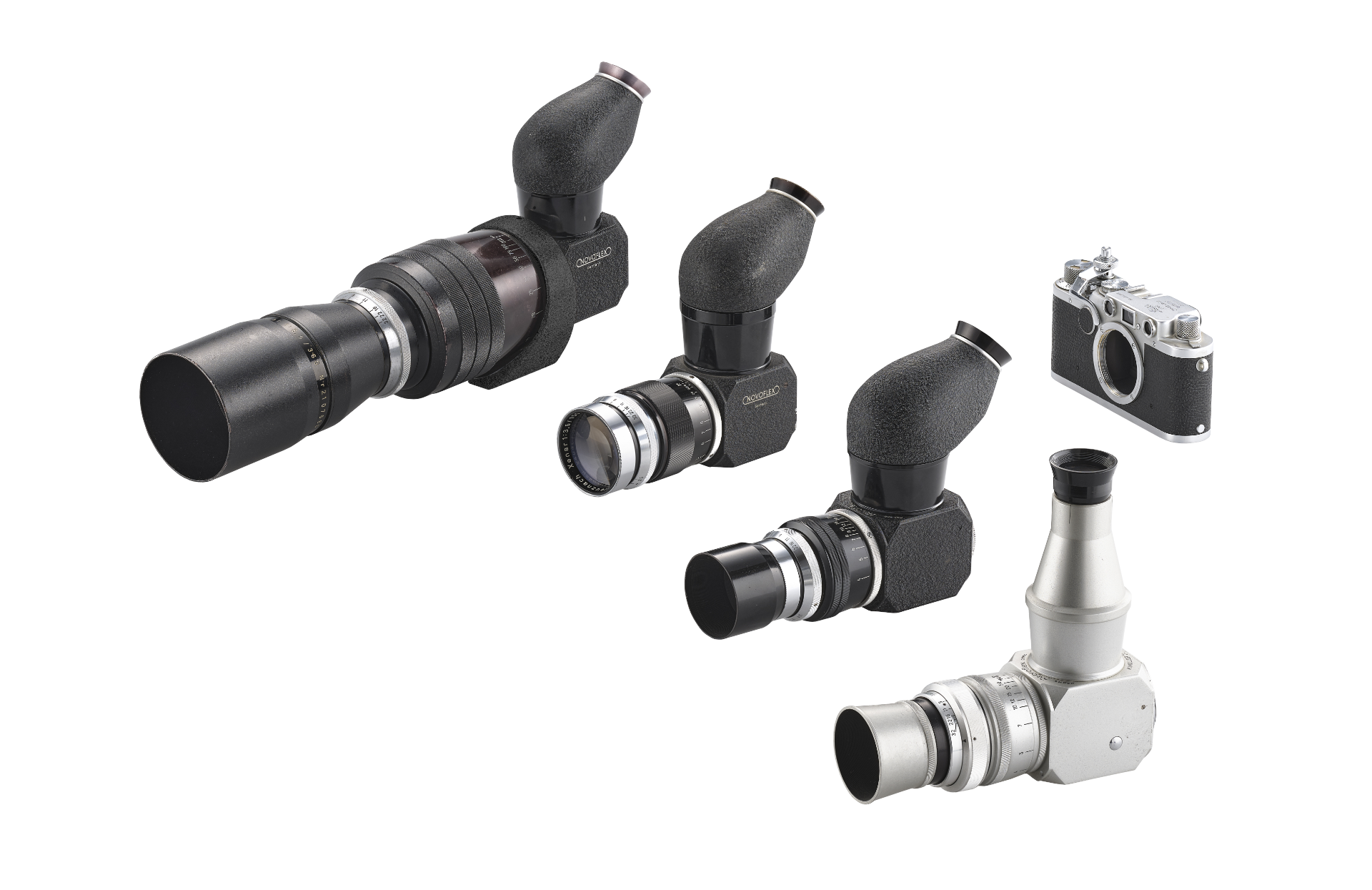
NOVOFLEX and Leica - Products from the Allgäu for the Cameras from the Lahn - Mirror Box
MIRROR BOX, MIRROR REFLEX DEVICE, MIRROR ATTACHMENT
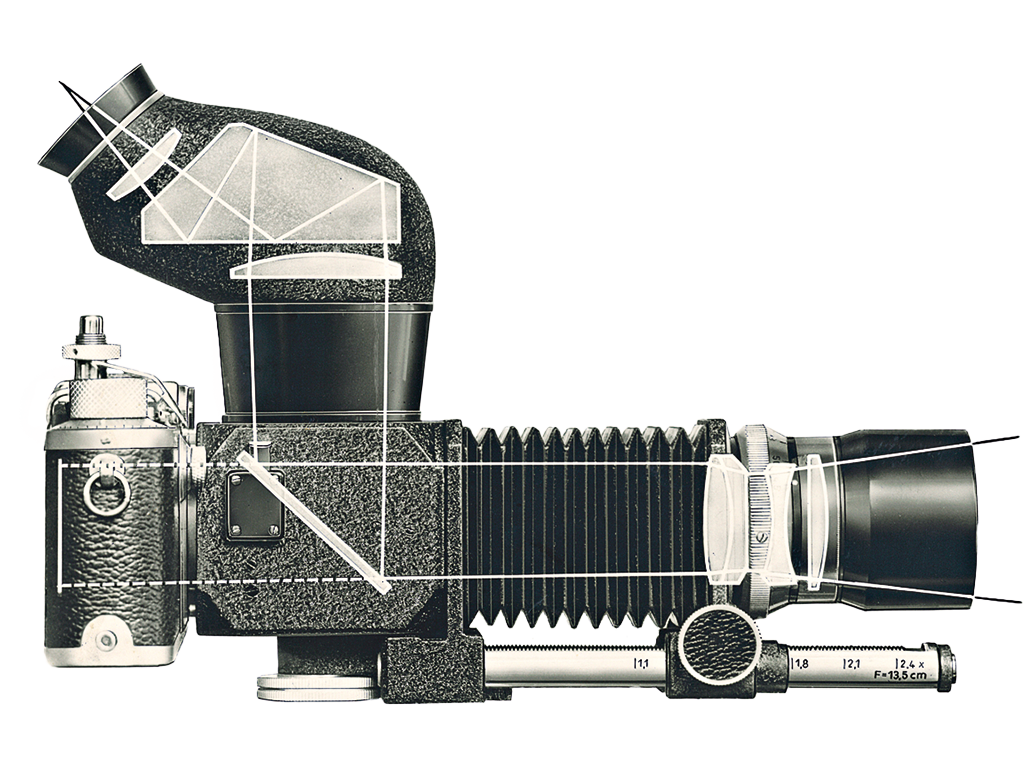
Visoflex adapter, mirror reflex unit — manufacturers of rangefinder cameras used a wide variety of terms for such accessories, all intended to overcome the basic limitations of rangefinder cameras in close-up and telephoto work. Leitz had been producing the PLOOT since the mid-1930s, Zeiss Ikon the Flektoskop1, and Nikon also began manufacturing its own mirror box for the S-series rangefinder cameras in 19512. It is therefore hardly surprising that Karl Müller Jr. began with exactly such a mirror box when he expanded the product range of his photo and radio business in 1948. A major weakness of all mirror boxes available at the time was the release mechanism and the synchronization of mirror movement with the camera shutter. All of these accessories were supplied with an awkward double cable release. That was the first point where refinement could begin.
On 2 October 1948, the “release device for SLR auxiliary devices for photographic cameras” was filed for patent protection. The product itself was given the very short-lived name Reproflex. In contrast to the mirror boxes of competing manufacturers, the Reproflex — and the later Novoflex mirror boxes — did not use a “combined or coupled cable release.” Instead, triggering was done by means of an aluminum release bridge placed over the camera release button, which pressed on a spring-loaded lever or pin mounted on the mirror box. This worked in both portrait and landscape orientation. At the time, this was a true novelty, and it was praised by contemporaries such as Leif Geiges, who wrote that “...the design of the release button is particularly successful, as it eliminates the need for a double cable release...”, and Dr. Otto Croy, who noted that “...through this uncomplicated lever release the camera, with the attached mirror housing, becomes a mirror-reflex ‘hand camera’...”4
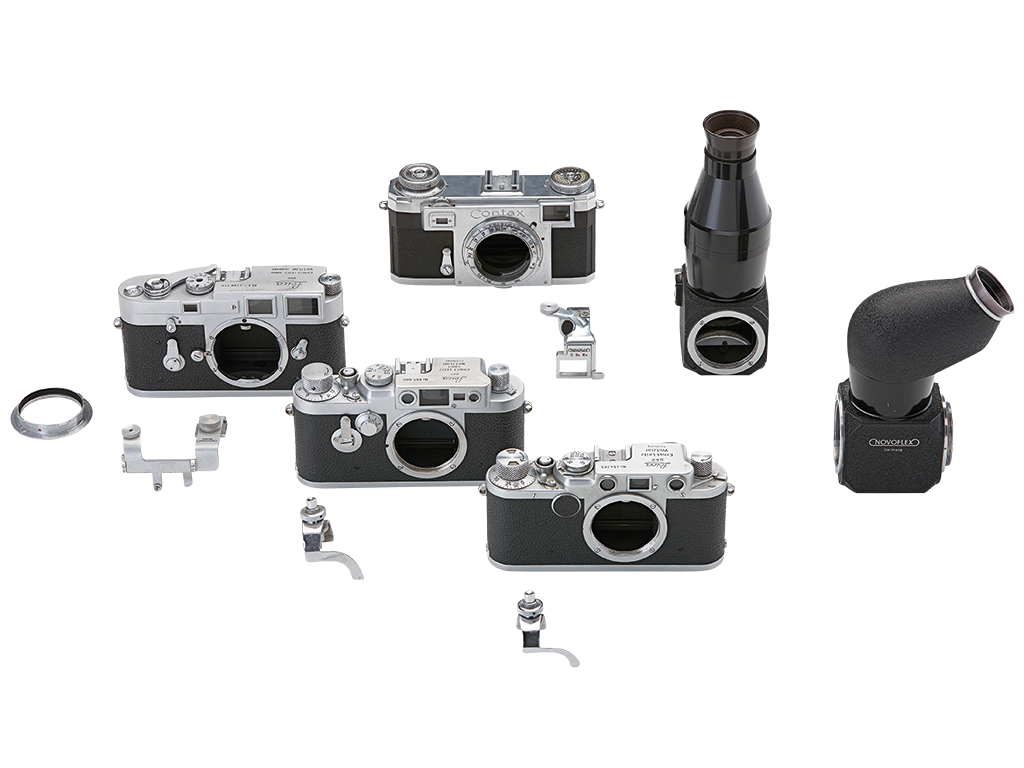
For Leica cameras, NOVOFLEX supplied three, or possibly four, different release bridges over time: 1. SYNAL for Leicas up to the IIIf, 2. SYNAL-G for the IIIg, 3. NOSYN for M Leicas up to the M4, and 4. a release bridge for the original Reproflex version with “lever instead of pin.”
All release bridges allowed precise adjustment of the time difference between mirror release and shutter release. If necessary, a cable release with Leica nipple bell could still be used with the release bridge. On 29 November 1948, Karl Müller Jr., through the Munich patent attorney Dr. Ing. E. Hoffmann, filed another utility model application entitled “Mirror reflex attachment for photographic cameras.”5 The designer Josef Waggin contributed an interesting idea: the innovation in this application was the locking rotary movement of the mirror box from portrait to landscape format by means of a push button mounted in the side wall. On the Leitz PLOOT, a square sliding catch still had to be operated, which was described as “hard to find and inconvenient to use, especially when speed is required.” Surprisingly, this push button disappeared again in series production, and the mirror boxes could then, after a one-time adjustment on the camera, be moved from portrait to landscape format by a leftward swivel.
In an earlier version of this text, I had assumed that this utility model had prevented Leitz from equipping early Visoflex I housings without this push button. That assumption was based on a note I found in the Leitz price list of March 1957. There, a footnote on page 6 states: “VISOFLEX adapters of the old design under no. 5412 can be fitted with rotation ... conversion price 42 DM.” After a phone call and email exchange with Lars Netopil, however, the situation appears somewhat different. Leitz seems to have begun referring to all mirror boxes built before the Visoflex II simply as “VISOFLEX adapter.” Up to about serial number 7500, the PLOOT version of the mirror boxes was produced. Apparently, there were also PLOOT housing variants without a swiveling camera mount. In the lists, these housings are referred to by the telegram code PICOO. The above note therefore appears to refer to these special PLOOT versions. Unfortunately, I was unable to find an illustration of the PICOO.
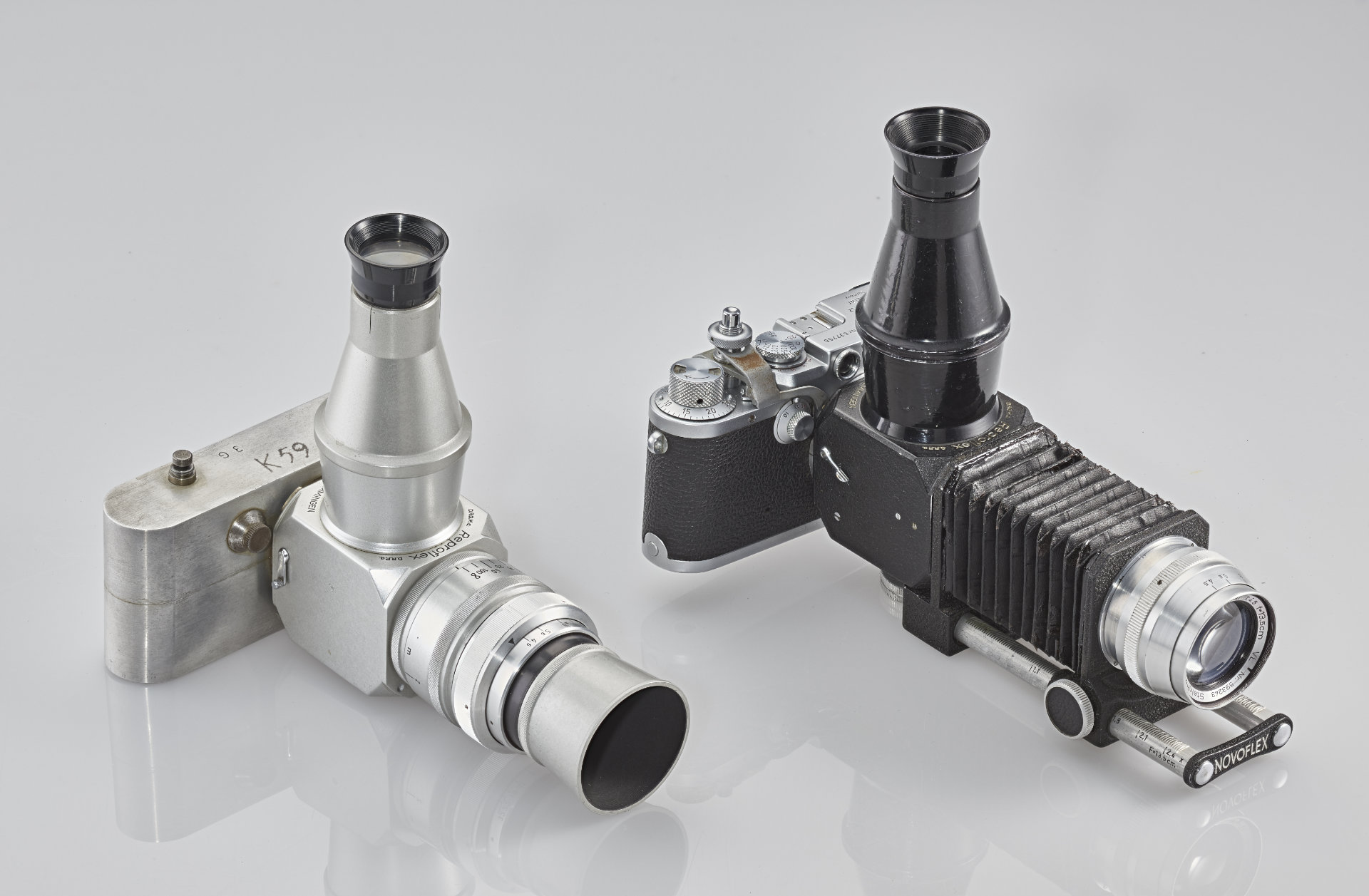
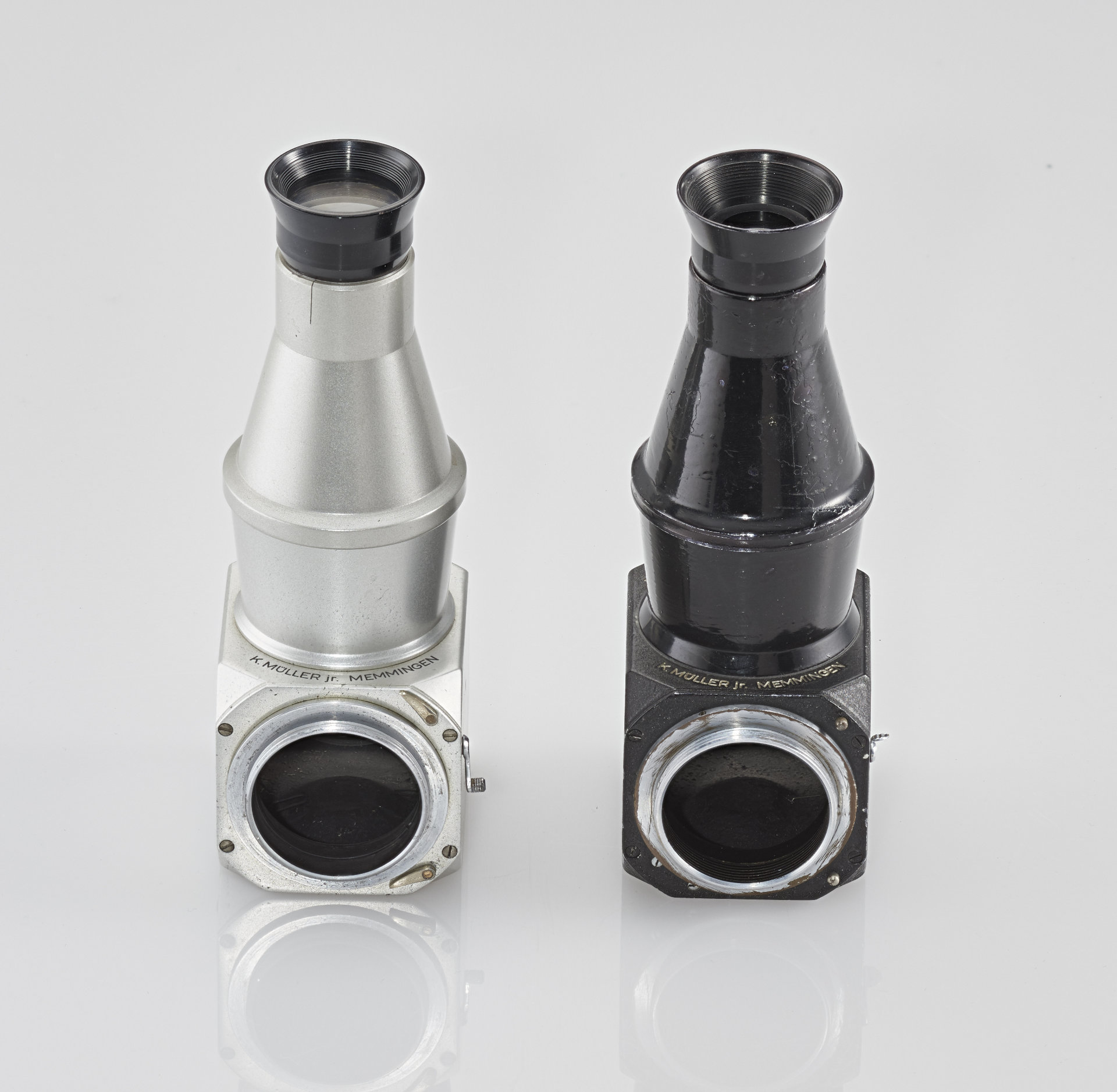
For collectors, the following information is of interest: the Reproflex mirror box was available in silver-matte anodized finish and in black lacquer. Under the Reproflex name, however, there seem to have been only very few models, though the exact number is unfortunately unknown. Also interesting are the differences in mirror release construction. While the silver unit still has small levers, the black-lacquered model already features the later pins. The two models therefore require different release bridges. The first undated price list available to me, probably from 1949, already lists the device as a “NOVOFLEX” product. The “NOVOFLEX” device, which was therefore probably available from 1949 onward, was soon replaced by the revised Model II, around 1951. The prism and the vertical viewing attachment of the later Version II cannot be used on the first version. Another difference from the PLOOT and Visoflex I is that the Reproflex/Novoflex housing lacks lugs for a carrying strap, and its mirror must be folded down manually after exposure using the side-mounted slider.
On 7 February 1951, Karl Müller Jr. also registered the name “NOVOFLEX” — from “nova” or “novo,” Latin for “new,” in the context of mirror reflex camera technology — as a trademark with the German Patent Office in Munich, and it was registered on 2 December 1952. The company name was then officially changed upon entry in the commercial register on 10 November 1953.6 From then on, the company traded under the name NOVOFLEX Fotogerätebau Karl Müller.
Meanwhile, another utility model filed on 31 March 19517 expanded the protective claims for the mirror box by stating that “the attachment head containing the prism magnifier is rotatably arranged on the magnifier tube of the finder. This makes it possible to move the prism magnifier from the working position into a second position offset by 180 degrees, which not only makes it easier to swivel the camera at the finder but also ensures space-saving storage ...” In other words, the 45-degree prism available from 1951 onward did not have to be removed for transport in the case, and it also allowed discreet candid shots when the prism head was swiveled 90 degrees to the side. Some 20 years later, NOVOFLEX would also use this prism principle in enlarged form in the prism designed for the Hasselblad 500 C/M.
The revised NOVOFLEX II mirror box and the accessories supplied with it were certainly impressive. Not only was the aforementioned 4x magnifying 45-degree prism finder now available, adjustable for eyesight up to +3 diopters, but Novoflex also supplied a bellows unit, later modified for use on the Visoflex I and considerably more compact than the Wetzlar version, as well as a focusing rail, filters, close-up lenses, extension rings, microscope adapters, adapters for Leitz lens heads, and two leather cases for storage and transport of the mirror box and accessories.
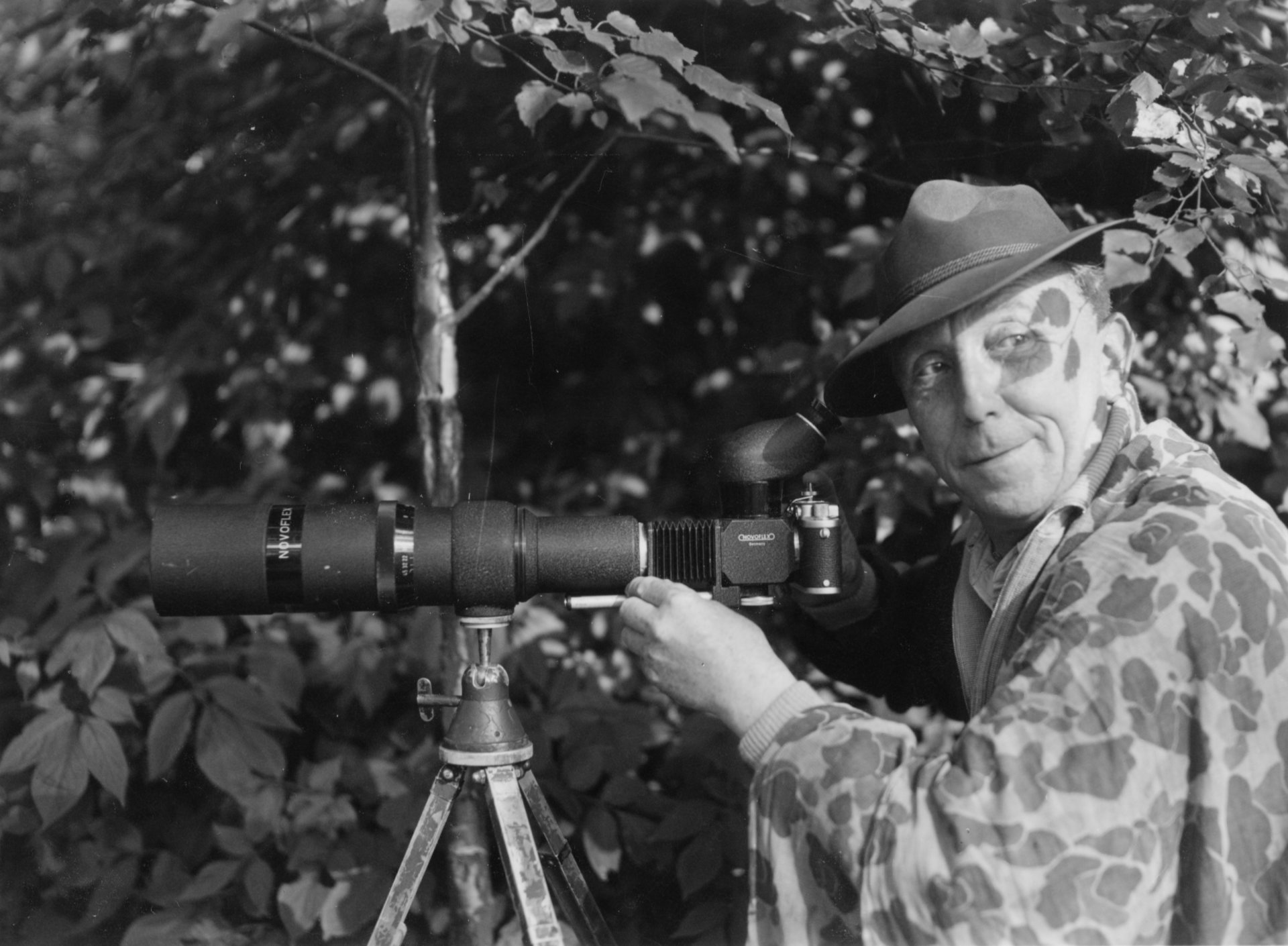
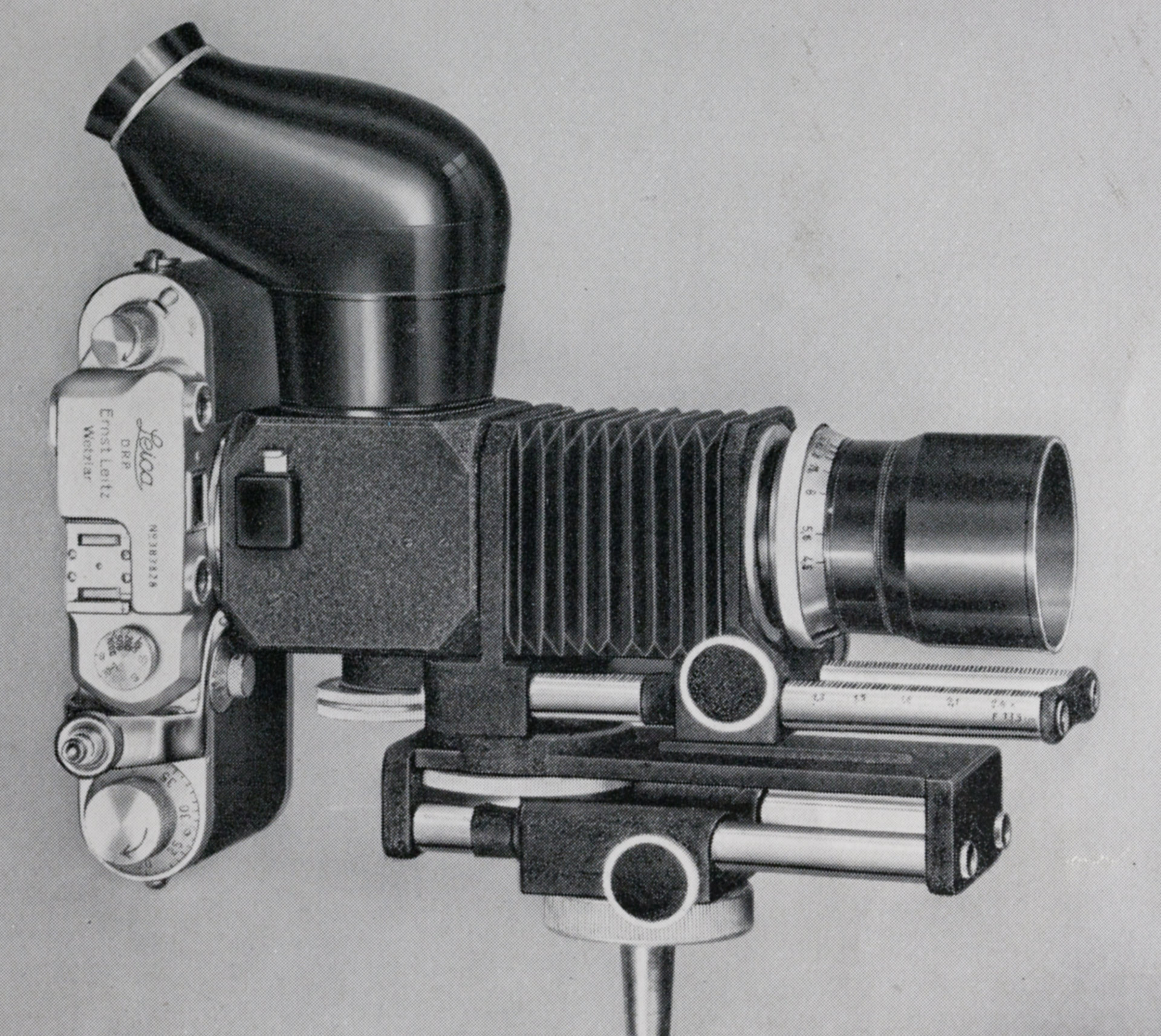
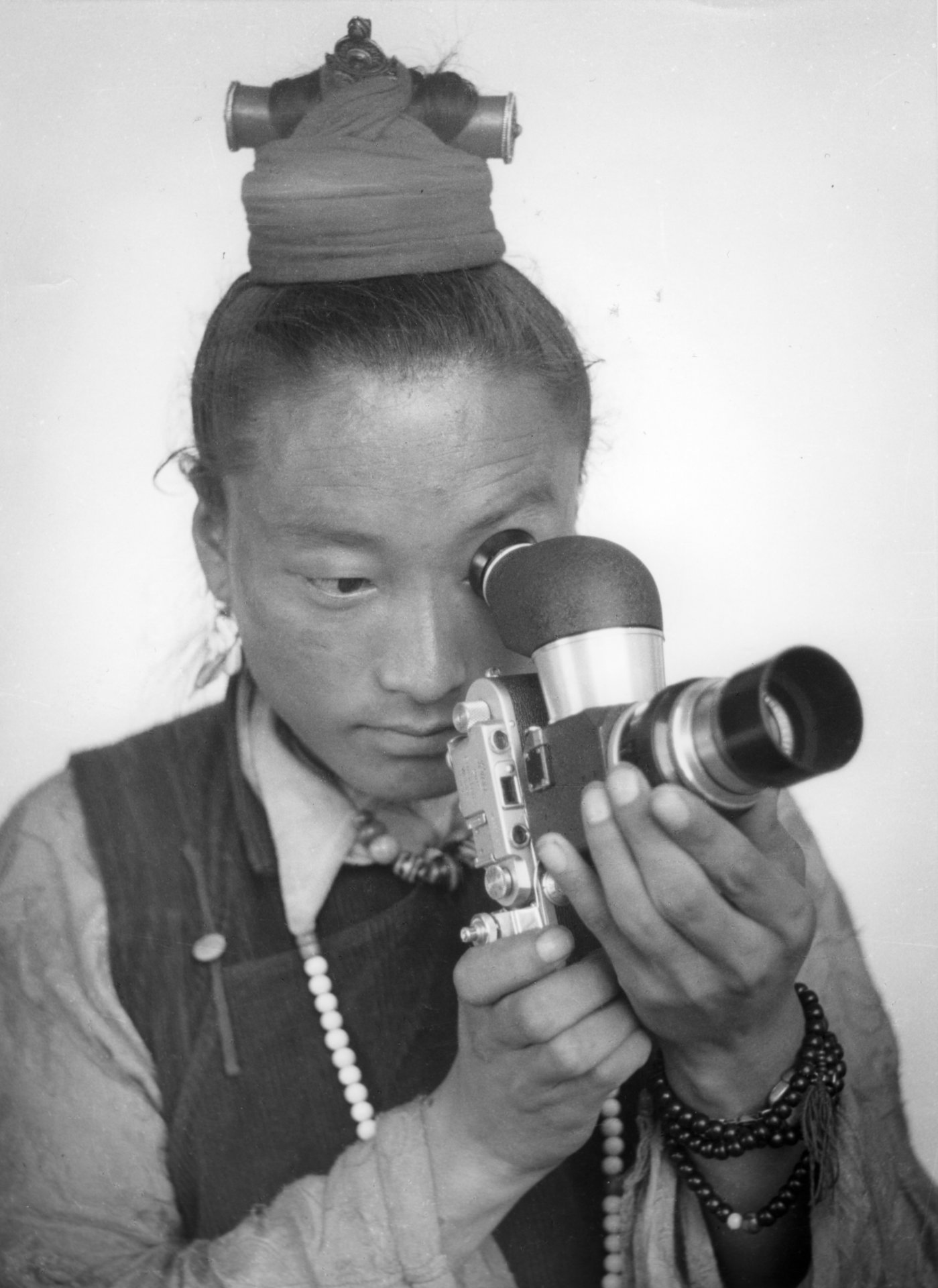
Novoflex also supported the user with a substantial range of lens heads and adaptation options. For focusing to infinity, the Schneider-Kreuznach Xenars 4.5/135 and 3.5/150, later 4.5/150, as well as the Steinheil Culminar 4.5/135, were offered. These could be used either on the bellows or directly on the mirror box via a separately available focusing mount, and in the case of the Culminar directly on the Leica with a long focusing mount and rangefinder coupling.
Since the Novoflex mirror box had the same register depth as the Leitz PLOOT and the Visoflex I (62.5 mm), the removable head of the Leitz Hektor 4.5/135 could also be used in combination with the short ZOOAN tube. However, this had to be sent to Novoflex so that the protruding threaded protective ring could be shortened. The Leitz Telyt 4.5/200 was also compatible.
For long-distance photography and “shots in the wild,” the Schneider-Kreuznach Tele-Xenar 5.5/360 — then the longest focal length in the range — was available as a specialty lens, with a double-engraved aperture ring and a special focusing mount. From 1953 onward, another lens head was added that would accompany NOVOFLEX for decades, with only minor modifications: the Fernbildlinse 5.6/400. At first it was focused conventionally through the bellows, and from 1955/56 onward it was fitted with the well-known Follow Focus handle.
In 1954, the Novoflex mirror boxes were modified one last time. With the introduction of the Leica M3, a minor adjustment to the tube carrying the ground glass became necessary in order to allow portrait-format swiveling with this camera as well. The 1 mm shorter flange focal distance of this camera was compensated by the EMLEI adapter ring, and a camera-specific release bridge, NOSYN, was now available. This applied to all housings from serial number 5000 onward and with Leica mount. After this final modification, the mirror box, equipped with Contax bayonet and a matching release bridge, TAXSYN, was also offered for the Contax IIa and IIIa.
The Novoflex mirror boxes disappeared from the price lists in 1961, but reappeared briefly in 1962, probably as part of a clearance sale. At that time, they were available ready for connection with release bridge, prism, and vertical viewing magnifier.
Sources
- ZEISS HISTORICA, Volume 25, Number 1, Spring 2003 - The transition from the Flektoskop to the Flektometer by Stefan Baumgartner, Lund, Sweden
- NIKON Rangefinder Camera, Robert Rotoloni, Second Edition 1983, Reprint - Hove Camera Books 1993
- Patent #869734, 2 October 1948, NOVOFLEX-Archive/DEPATISnet - DPMA
- NOVOFLEX Price List 1.8.1951 - Testimonials pages 2-4
- Utility Model Specification 1608423/NOVOFLEX-Archive/DEPATISnet - DPMA
- Commercial Register extract Memmingen Local court/NOVOFLEX-Archive
- Utility Model Specification 1623266/NOVOFLEX-Archive/DEPATISnet - DPMA
- NOVOFLEX Price List 1958